
Device plugins
A device model can be a file instead of Go code that has to be compiled into the emulator. Two formats are supported:
- Lua (
.lua) runs inside a bundled Lua 5.4 interpreter compiled to WebAssembly; - WASM (
.wasm) runs directly.
Both use the same small bus ABI. Desktop and the headless runner execute them with wazero’s compiler; the browser uses the native WebAssembly engine, with JavaScript host imports bridging back to Go. This is how the four built-in presets grow into a device ecosystem: anyone can share a BME280, a flash chip, a modem or a companion radio as a file.
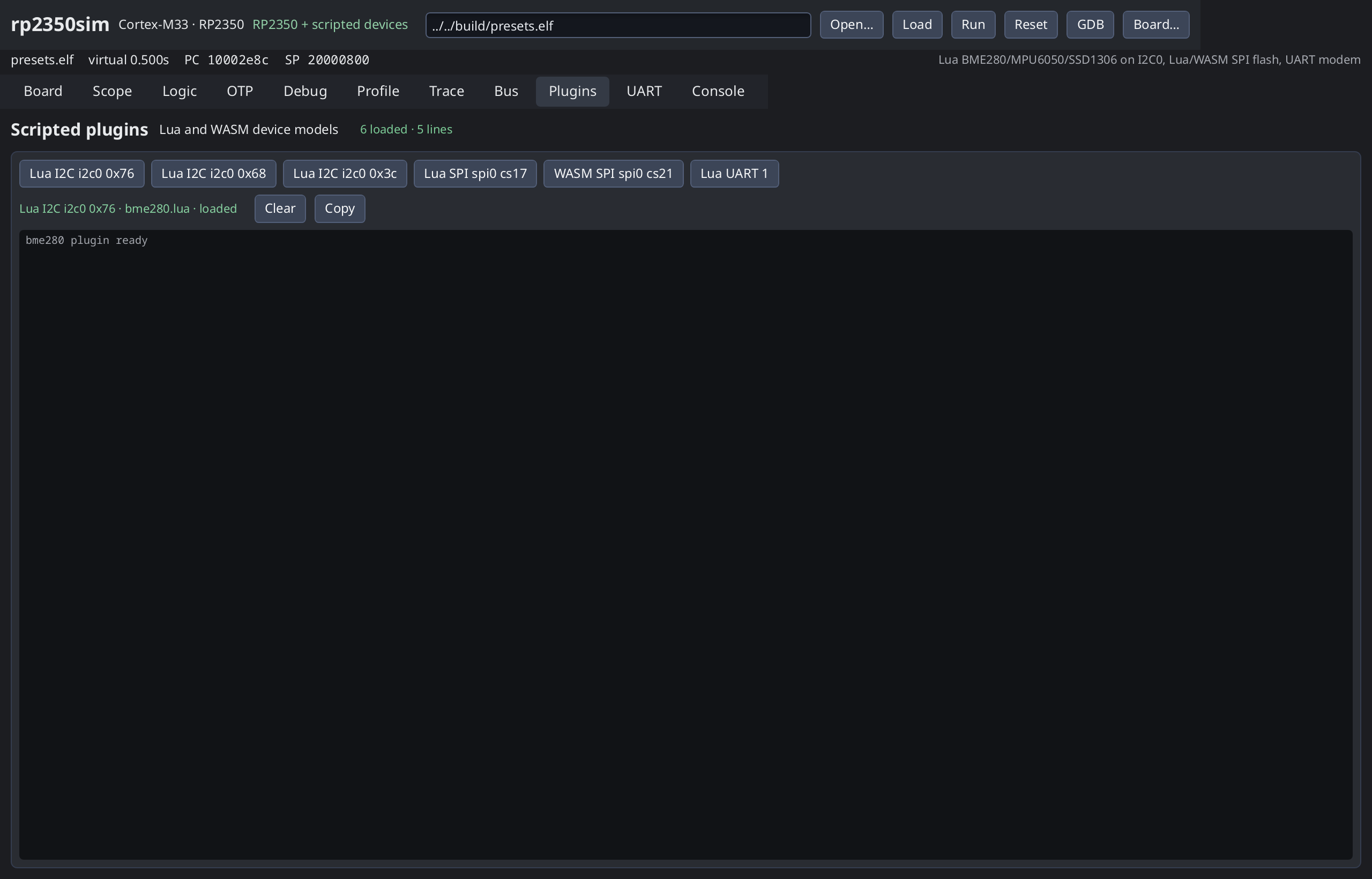
The built-in pico2-plugins board loads the Lua examples and a compiled WASM
flash. Its presets.elf firmware probes the Lua BME280, MPU6050 and SSD1306 on
I2C0, the Lua W25Q16 on SPI CS GP17 and the compiled WASM flash on CS GP21:
task ui:plugins
# or
rp2350sim-ui --board pico2-plugins --tab bus build/presets.elf
# browser demo, with the firmware and plugins served by URL
task wasm:plugins
The embedded pico2-plugins demo resolves its file: paths relative to
cmd/simui (where the UI module runs), so use the tasks from a checkout; the
browser variant uses the url: fields instead.
From a board YAML file:
i2c_plugins:
  - { bus: 0, addr: 0x76, file: plugins/examples/bme280.lua }
spi_plugins:
  - { bus: 0, cs: 17, file: plugins/examples/w25q16.lua }
serial_plugins:
  - { uart: 1, file: plugins/examples/uart-modem.lua }
The complete schema, file/url rules and conflict validation are in the
boards.yaml reference.
From the headless runner:
rp2350sim -fw build/presets.elf -seconds 1 \
  -i2c-plugin 0:0x76=plugins/examples/bme280.lua \
  -spi-plugin 0:17=plugins/examples/w25q16.lua \
  -uart-plugin 1=plugins/examples/uart-modem.lua
-i2c-plugin  bus:addr=path
-spi-plugin  bus:cs=path
-uart-plugin uart=path
Users do not need a Lua or C toolchain. device_lua.wasm is checked into the
repository and embedded in both binaries; a .lua file is the only file the
user ships.
The interpreter is built from Lua 5.4.7 with wasi-sdk as C++ using the wasm
exception-handling proposal (Lua raises through longjmp). scripts/plugins/build.sh
owns the build and internal/deviceplugin/assets/device_lua.wasm is the
artifact. The interpreter is a reactor: the host calls its exports and the
script is data.
A Lua plugin returns a table with a new(config) constructor. The constructed
table uses colon methods:
return {
  new = function(config)
    local d = { ptr = 0, first = true, regs = {} }
    d.regs[0xD0] = 0x60 -- chip id

    function d:i2c_begin(addr) d.first = true end
    function d:i2c_write(b)
      if d.first then d.ptr = b; d.first = false
      else d.regs[d.ptr] = b; d.ptr = (d.ptr + 1) % 256 end
      return true -- ACK
    end
    function d:i2c_read()
      local v = d.regs[d.ptr] or 0
      d.ptr = (d.ptr + 1) % 256
      return v, true
    end
    function d:i2c_end() end

    -- SPI plugins implement spi_select(active) and spi_transfer(tx)
    -- UART plugins implement uart_tx(b)
    -- d:tick(us) and d:reset() are optional
    return d
  end,
}
Optional methods:
| method | meaning |
|---|---|
i2c_begin(addr) / i2c_write(b)->ack / i2c_read()->byte,ack / i2c_end() |
I2C target; return false or nil to NAK |
spi_select(active) / spi_transfer(tx)->byte |
SPI target, called on every CS edge and byte |
uart_tx(b) |
firmware byte; answer with uart_send("...") |
tick(us) |
virtual-time callback (1 ms grid) |
reset() |
chip/reset hook |
Lua helpers available to a plugin:
print("...")           -- a log line
uart_send("OK\r\n")    -- bytes back to the firmware UART
gpio_write(pin, true)  -- drive a configured line (IRQ, reset, ...)
gpio_read(pin)         -- read a configured line
now_us()               -- virtual time
config is passed as a Lua table. It is the config: mapping from
boards.yaml (or empty). Lua tables, strings, numbers and booleans are
supported.
The standard libraries are limited to base, table, string, math,
utf8 and coroutine; io, os, package and debug are not available.
A .wasm plugin implements the same ABI directly. It must export:
plugin_abi_version() -> i32        // 1
plugin_alloc(size) -> ptr
plugin_init(config_ptr, config_len) -> i32 // 0 ok
plugin_reset()
plugin_tick(us: i64)

i2c_begin(addr) / i2c_write(b)->i32 / i2c_read()->i32 / i2c_end()
spi_select(active) / spi_transfer(tx)->i32
uart_tx(b)
and may import from plugin:
host_log(ptr, len)
host_now_us() -> i64
host_gpio_write(pin, level) -> i32
host_gpio_read(pin) -> i32
host_uart_send(ptr, len) -> i32
i2c_read returns -1 for NAK. plugin_init receives JSON config bytes.
A minimal SPI example is in plugins/examples/wasm/spi-flash.c; the compiled
plugins/examples/spi-flash.wasm is attached by the pico2-plugins board
alongside the Lua models.
Plugin print() (and WASM host_log) lines appear in the Plugins tab. Pick a device from its Lua/WASM slot buttons to open that
device’s scrollable console; Clear drops its buffer and Copy exports it.
The CLI writes the same lines as plugin slog records, so -quiet still
leaves warnings and errors visible. This is the first place to look when a
script fails to parse or a constructor throws.
A UART plugin receives every byte the firmware writes and can inject bytes
back with uart_send. It is enough to mock a serial companion such as an
nRF5340 host interface or a modem: keep a receive buffer in the script,
implement the framing and command/response set, and use tick for
unsolicited events. plugins/examples/uart-modem.lua is a small AT-command
example.
The UART tab shows the raw UART byte stream in both directions, so the
firmware’s requests and the script’s responses can be inspected separately
from the Plugins tab’s print/host_log output.
nRF7002-class parts use an SPI host interface; use spi_select/spi_transfer
and gpio_write for the IRQ line. The examples are deliberately generic—
implement the protocol subset your firmware and driver actually use.
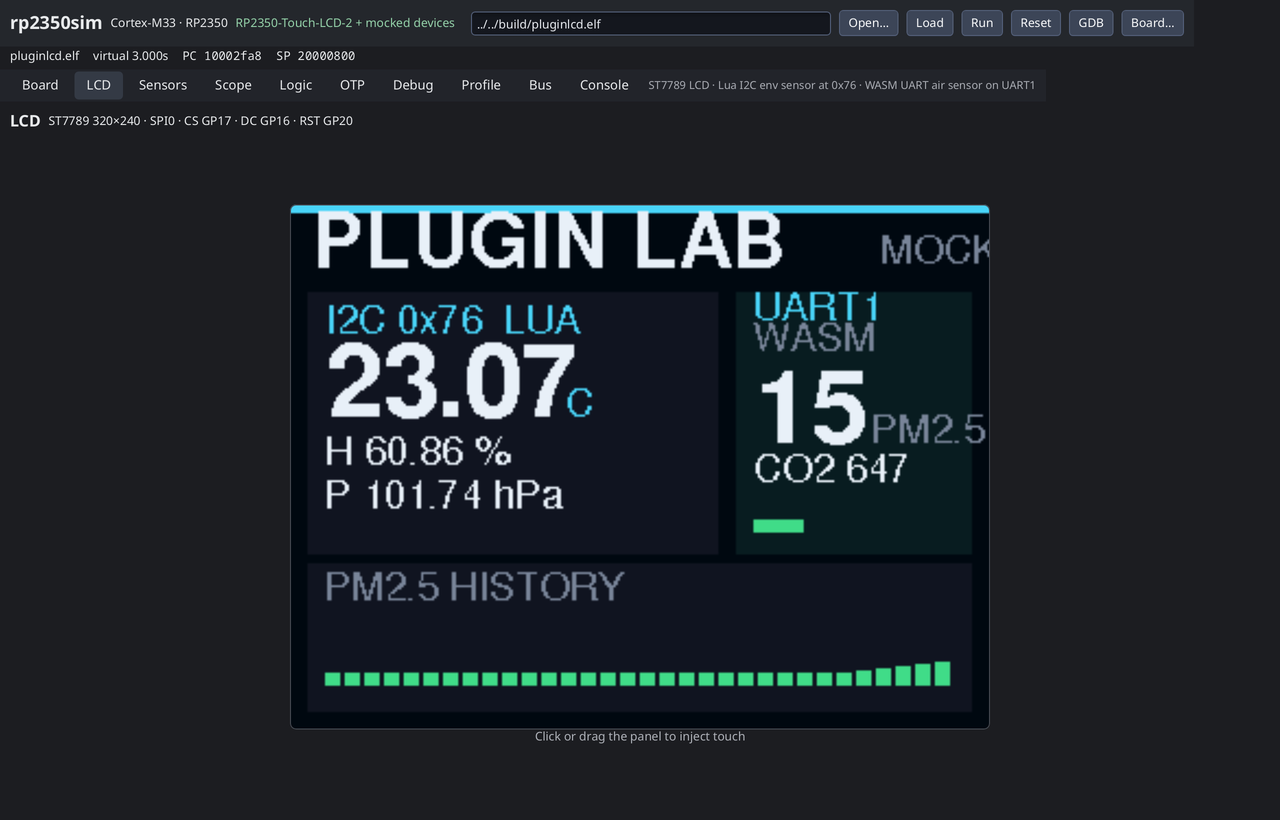
The touch-lcd2-plugins board is the end-to-end example: a TinyGo firmware
reads a Lua environment sensor on I2C0 and a compiled WASM air-quality sensor
on UART1, then paints both on the 320×240 ST7789. No device is physically
attached; the firmware uses ordinary machine.I2C0 and machine.UART1 calls.
i2c_plugins:
  - { bus: 0, addr: 0x76, file: plugins/examples/env-sensor.lua }
serial_plugins:
  - { uart: 1, file: plugins/examples/aq-sensor.wasm }
env-sensor.luaexposes a register pointer, a chip id at0x00, and big-endian temperature/humidity/pressure at0x01–0x06. Itstickupdates the values so the dashboard moves.aq-sensor.wasmanswersIwith an identity andRwithAQ,pm25,co2,temp,hum; the firmware sendsRfour times a second. The same protocol is implemented inaq-sensor.lua, so swappingfile: ...aq-sensor.wasmfor the Lua file needs no firmware change.- The firmware is
firmware/pluginlcd; the board adds the plugin entries to the ordinary Touch-LCD-2 hardware definition.
task ui:pluginlcd       # live dashboard on the LCD tab
task ui:pluginlcd:png   # headless render
task plugins:wasm:aq    # rebuild aq-sensor.wasm from C (clang)
The headless equivalent:
rp2350sim -fw build/pluginlcd.elf -seconds 3 \
  -i2c-plugin 0:0x76=plugins/examples/env-sensor.lua \
  -uart-plugin 1=plugins/examples/aq-sensor.wasm
The plugin tick is a 1 ms virtual grid, not a per-cycle or per-microsecond
callback. This matters: an early 1 µs tick made the pico2-plugins board look
like a 0.04× machine even though the models were idle. With the 1 ms grid the
same presets.elf run is close to the no-plugin baseline.
Measured on the development host (desktop, wazero compiler; three virtual
seconds, presets.elf):
| setup | wall time |
|---|---|
| no plugins | ~0.68 s |
| five Lua plugins + one C WASM plugin | ~1.1 s |
| one C WASM SPI plugin | ~0.68 s |
A four-call SPI transaction (select + three bytes) benchmarks at roughly 9.5 µs in Lua and 6 µs as compiled C WASM. These are host timings, not emulated bus rates.
In the browser the native engine executes the same files. 12-second
presets.elf runs in headless Chromium reached 3.3–3.5 virtual seconds both
with and without the six-plugin pico2-plugins board, so the native plugin
path adds no measurable cost beyond run-to-run noise.
The Lua interpreter artifact itself is checked in at
internal/deviceplugin/assets/device_lua.wasm and embedded in the binaries.
Users never need a Lua or C toolchain; task plugins:build is only for
maintainers changing the shim. In the browser the embedded Lua module is
instantiated by the page’s native WebAssembly engine, with the small WASI
subset provided by the host bridge.
Desktop plugin calls have a per-call deadline and a memory cap; a script that
loops forever is stopped, marked failed and reported in the Plugins tab. The
browser’s native WebAssembly engine cannot preempt a synchronous call, so the
same budget is not available there. Lua exposes only the base, table, string,
math, utf8 and coroutine libraries; os, io and debug are absent, and
dofile/loadfile are removed. clock() and time() follow virtual time.
UART pins on a board restrict gpio_read/gpio_write; the CLI plugin form
leaves GPIO unrestricted for command-line experiments.
- Plugins are trusted local files. Desktop calls have a deadline and a memory cap, but they still run in the emulator’s process and are not a security boundary; the browser cannot preempt a synchronous call. Lua libraries are restricted and WASM has no filesystem or network imports.
- Desktop and headless runs use wazero’s compiler; the browser uses the native WebAssembly engine with JavaScript/Go host imports. A browser still pays the JS/Go boundary on each callback, so use compiled WASM for hot SPI paths.
- Plan on a reset to re-create plugin state; plugins are attached when the chip is built. Board YAML changes require a reload.
- The ABI is versioned (
plugin_abi_version= 1). An unsupported version or missing export is a load error, not a silent default. - The browser path needs native WebAssembly exception handling for the Lua runtime (current Chrome and Firefox). A browser without it reports the instantiation error in the Plugins tab instead of using a fallback interpreter.
task plugins:build    # rebuild device_lua.wasm (needs wasi-sdk + Lua source)
task test:js          # plugin tests on the native engine (Node, js/wasm)
task ui:plugins       # the pico2-plugins board in the Plugins tab
task ui:plugins:png   # render it to build/ui-plugins.png
task wasm:plugins     # serve the same board and firmware in the browser
The browser build copies plugins/examples/ into build/web/plugins/ so the
same board and URLs work in the browser demo.